
Reviewed · BELFAST TROUBLES AND MURAL TOURS
The Troubles Tour- Two Stories, One Journey
Belfast’s Troubles Tour puts you on the streets where the conflict unfolded, not in a museum removed from daily life. In about three hours, you walk from Divis and the Falls Road to the Shankill Road, seeing murals, memorial gardens, the Peace Wall, and the sites of major deaths.
I like the local guides, especially the chance to hear personal reflections from people who lived through the Troubles. I also like the clear two-community structure: Republican sites come first, then the tour crosses into Loyalist territory. The main drawback is emotional and physical: you walk about 4km, spend plenty of time standing, and visit memorials connected to IRA and UVF deaths.
Key points to know before booking
- The tour begins at Divis Street and ends near the Shankill Road, rather than returning to City Hall.
- Two local certified guides lead the experience, giving you more than a simple mural photo walk.
- The route covers Republican and Loyalist viewpoints, including memorial gardens that can be politically sensitive.
- The 14m Peace Wall is a central stop, with time to leave a personal message about peace.
- The group is capped at 25 people, which helps keep the walking tour personal.
- The walk covers about 4km, with frequent stops and a lot of standing at outdoor sites.
Why this Belfast walk matters
The Troubles were not an abstract political dispute. They shaped neighborhoods, families, streets, schools, churches, and daily routines. This tour helps you see that reality through places that still carry political meaning.
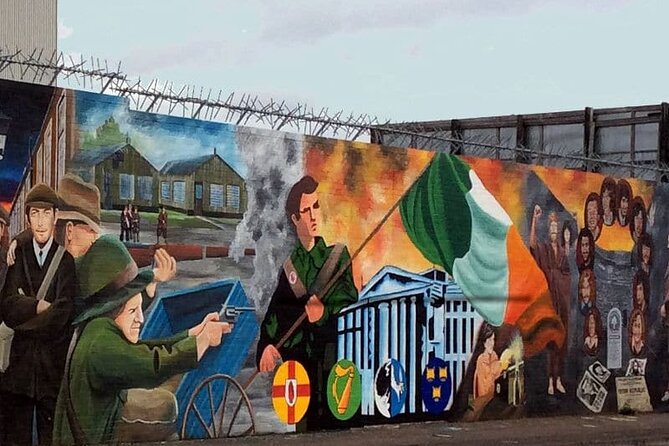
You walk through areas associated with the Republican Falls Road and Loyalist Shankill Road communities. Murals mark deaths, political causes, prisoners, international struggles, and local identity. Memorial gardens honor people killed during the conflict. Gates between the two areas still close at night.
That last detail matters. Belfast has changed greatly, but the division is not simply a historical display. Some of the barriers and symbols remain part of ordinary life. You get a more honest sense of the city by seeing that tension up close.
I also appreciate the tour’s format. It does not stop at one famous mural and call the job done. The route connects memorials, political art, religious places, a bomb site, and the Peace Wall. Taken together, those stops show how each community remembers its own dead and explains its own story.
The tour is offered in English and costs $23.36 per person. For three hours with two local certified guides and roughly 4km of walking, I consider that a fair price. You are paying mainly for interpretation and local context, not admission tickets, since the listed stops are free. That is exactly why the guide matters.
More belfast troubles and mural tours in Belfast:
- Belfast’s Political Mural Taxi Tour
★ 5.0 · 1,180 reviews - Belfast Troubles Tour: Walls and Bridges
★ 5.0 · 853 reviews - Famous 1.5 hour Belfast Murals Tour
★ 5.0 · 477 reviews
Starting at Divis and the Lower Falls
The walk begins at 30 Divis Street, Belfast BT12 4AL. Divis was once Belfast’s tallest building and had a British Army observation building on its roof. The area also became the location of two of the first deaths on the night the Troubles broke out in August 1969.
This is a strong opening because it places you at the beginning of the conflict’s most violent period. Instead of starting with a general political lecture, the guide can connect the wider story to one specific part of Belfast.
You should expect to spend around 10 minutes here. Admission is free, but the real value comes from what the guide explains about the building, the army presence, and the events of 1969.
The stop may feel stark compared with later murals. That is part of its purpose. Divis gives you a physical starting point before the route turns toward public memory and political identity.
Reading the International Mural Wall
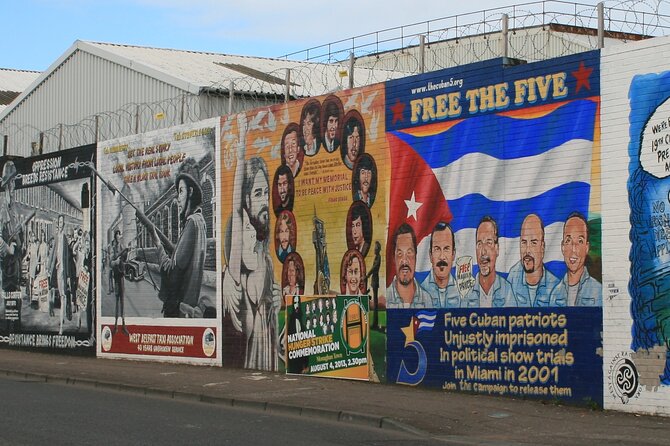
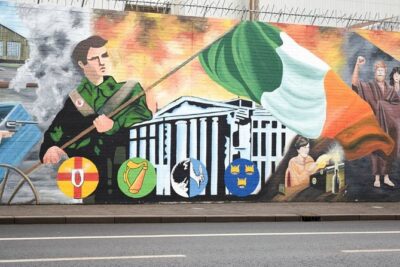
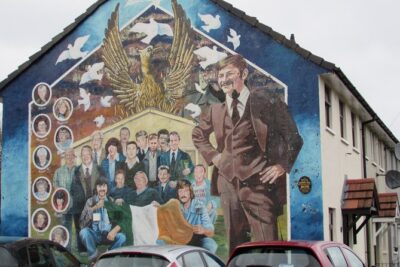
From Divis, the route continues to the International Mural Wall on Divis Street. You have about 15 minutes to look at an array of murals showing local events and conflicts from around the world, past and present.
This is one of the best places to slow down and study the images. Belfast murals are not just decoration. They can honor the dead, support political causes, explain a community’s identity, or connect local events with struggles elsewhere.
The International Mural Wall also helps you see that the art is not limited to one narrow version of Belfast’s past. The subjects range beyond Northern Ireland, giving the wall a wider political frame.
I would take notes here if you are interested in political art. The images change over time, and the guide’s explanation can help you notice details that a quick photograph misses. The 15-minute stop is useful, though anyone wanting a long, careful look at every mural may find it brief.
Republican remembrance at the Garden of Remembrance
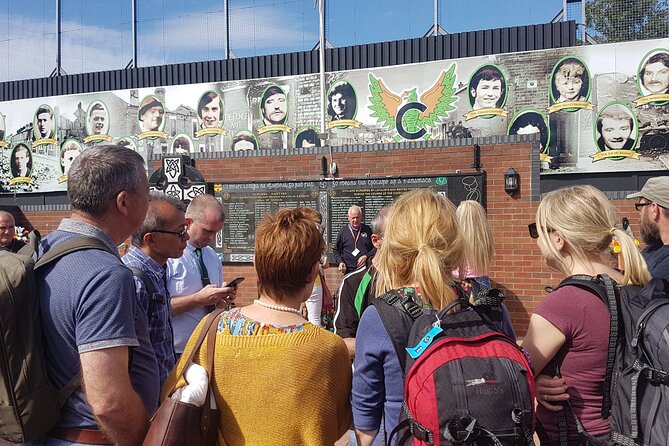
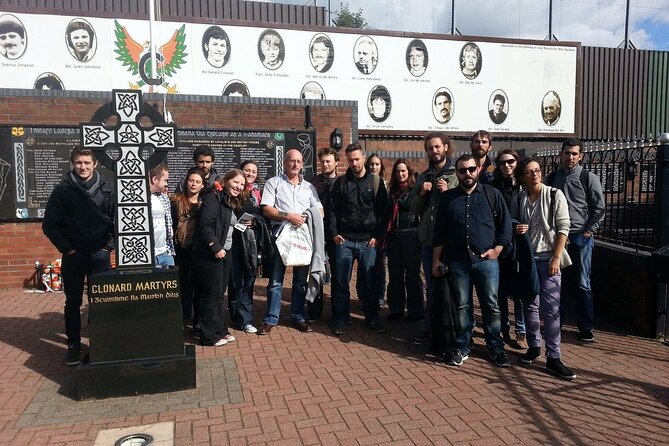
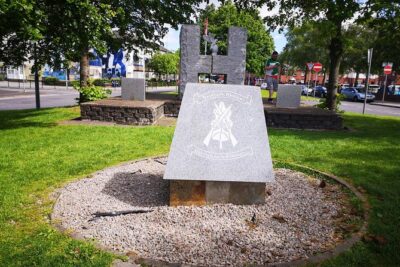
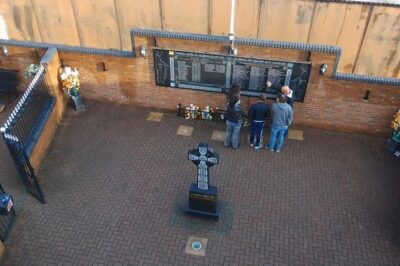
The Garden of Remembrance recalls local Republicans from the Lower Falls Road area who lost their lives during the conflict. It is one of two memorial gardens visited on the route.
This can be a difficult stop for visitors who are unfamiliar with how Belfast communities remember the Troubles. The garden honors people associated with the IRA, so the site may feel controversial, particularly if you come expecting one neutral public memorial shared by all sides.
The right approach is to listen carefully and avoid treating the garden as a simple approval or rejection of the political cause. The tour gives you a chance to understand how one community remembers its dead. That is useful, even when the viewpoint is uncomfortable.
You spend about 10 minutes here. Keep in mind that memorials connected to armed groups are not only about the past. They can still carry strong feelings for local people.
Same city, a completely different kind of day:
- Titanic Belfast Entrance Ticket: Titanic Visitor Experience Including SS Nomadic
★ 4.5 · 3,698 reviews - Cab Tours Belfast Famous Black Taxi Tours
★ 5.0 · 3,633 reviews - Giant’s Causeway Day Trip from Belfast
★ 5.0 · 3,480 reviews - A History of Terror – Belfast City Centre Walking Tour
★ 5.0 · 2,883 reviews
Bobby Sands and the power of one mural
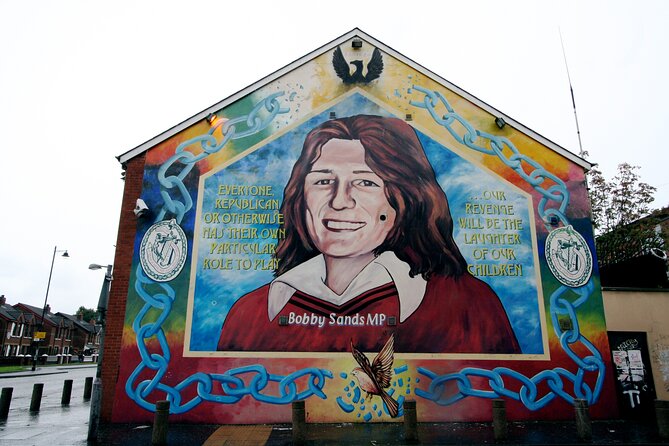
The Bobby Sands Mural is among Belfast’s best-known political images. Sands died on hunger strike at the Maze prison in 1981.
The mural is a direct introduction to one of the most important episodes of the conflict. Sands became a powerful Republican symbol, and his death drew international attention to the status of Republican prisoners and the wider struggle.
You have about 10 minutes at the mural. This is a compact stop, but it can lead to a longer discussion about imprisonment, protest, political representation, and the way murals turn an individual into a public symbol.
This is also a good place to remember that murals work in several ways at once. For some people, the image represents sacrifice and political resistance. For others, Sands remains connected to an armed movement. The guide’s job is not to flatten those views into one easy message.
Clonard Monastery and the road to peace talks
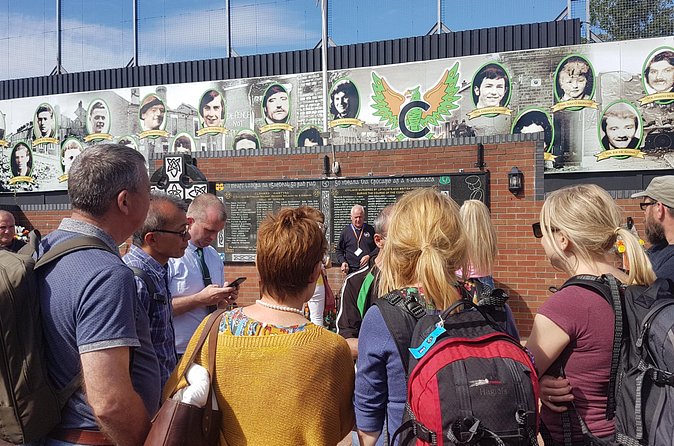
Clonard Monastery is one of the tour’s most important places for understanding how the conflict moved toward negotiation. Father Alex Reid was the resident priest and played a major role in the early talks that eventually helped lead to the Good Friday Agreement.
The monastery adds a different layer to the tour. The earlier stops focus heavily on deaths, prisoners, murals, and community memory. Here, the story turns toward contact between people on opposing sides and the difficult work of beginning talks.
You spend about 10 minutes at the monastery. The site is especially valuable if you want to understand that the Good Friday Agreement did not appear from nowhere. Conversations, contacts, and small steps came before the final political agreement.
I like this pause in the route because it prevents the tour from becoming only a sequence of violent events. It shows that people also built channels for communication, even when trust was thin.
The Clonard Martyrs Memorial Garden
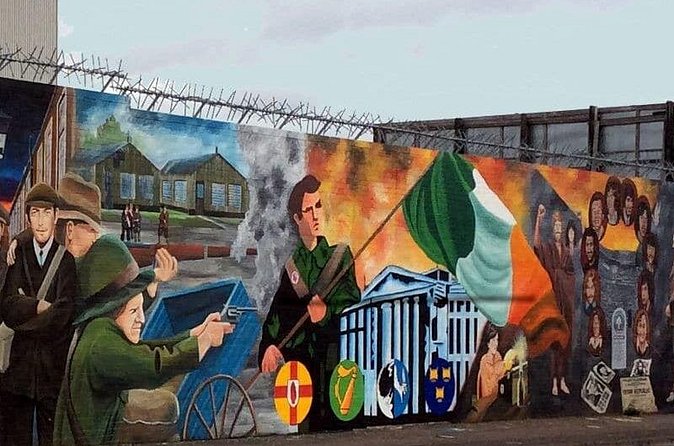
The second memorial garden is the Clonard Martyrs Memorial Garden. It honors Republicans from the Clonard area and is generally accepted as the place where the Troubles broke out in August 1969.
This stop brings the route back to the beginning of the conflict, but from the perspective of another local community. You see how a particular area marks its own dead and how geography becomes part of collective memory.
Again, the word martyrs carries political weight. You may find the language challenging, especially if you are trying to keep a neutral view. That is not a reason to skip the stop. It is a reason to pay attention to how communities use memorials to explain suffering, loyalty, and loss.
The tour allows about 10 minutes here. You will be outdoors and standing, so comfortable shoes and a willingness to listen are more important than rushing to take photographs.
Gates, barriers, and the Peace Wall
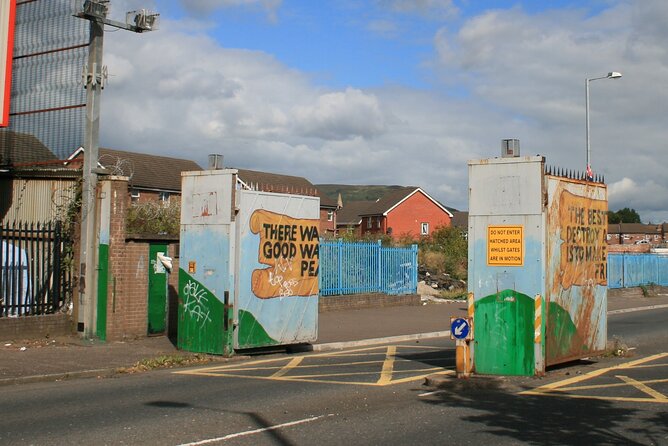
The route includes the gates between the Loyalist Shankill Road and the Republican Falls Road. These gates still close nightly, a practical reminder that the separation between the communities has not vanished.
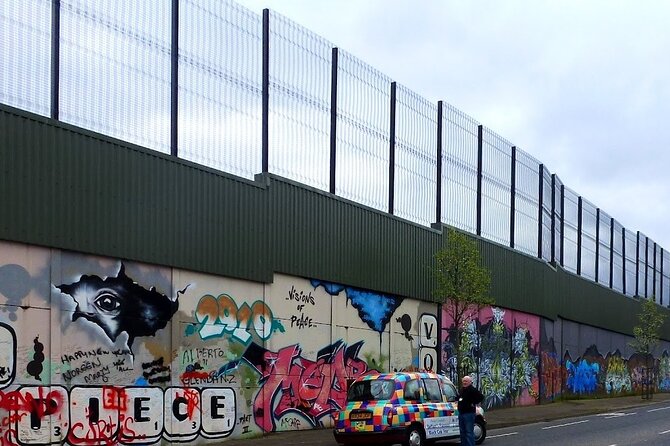
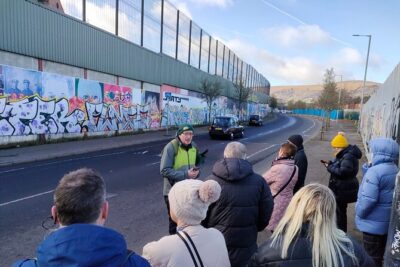
The Peace Wall is 14m high and divides the two communities. You have about five minutes to sign it and leave your thoughts about peace.
That short stop can carry considerable weight. The wall is both a symbol of conflict and a place where people express hopes for a less divided future. You may find the act of writing on it simple, even a little tourist-like, but the setting gives it meaning. You are not signing a generic attraction. You are leaving a message on a barrier built in response to real fear and violence.
The wall also raises an important question: can a structure built to separate people become part of a peace process? The tour does not require you to answer that neatly. It gives you the place and the background to think about it.
Crossing into Shankill Road
The tour then moves onto the Loyalist Shankill Road. This change of area is central to the promise of hearing two stories in one journey.
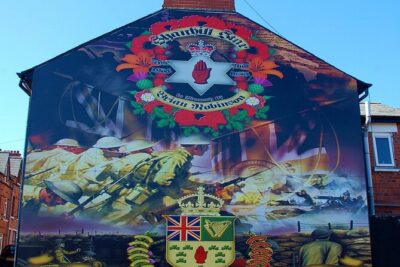
One stop features a UVF mural remembering seven members of the organization who died during the conflict. As with the Republican memorial gardens, this is politically sensitive. The mural reflects Loyalist remembrance, and you should view it as an expression of community identity rather than as a neutral public monument.
A second Shankill stop marks the site of the Shankill bombing, where nine people lost their lives. The tour allows about 10 minutes there.
Together, these stops create an important contrast with the earlier Republican sites. You see that both communities have memorials, symbols, and accounts of loss. You also see why a simple good-side and bad-side version of the Troubles fails to explain how people in Belfast experienced the conflict.
The Shankill section is short, with about five minutes at the UVF mural and 10 minutes at the bombing site. That keeps the full walk within roughly three hours, but it means you should listen closely and ask questions when the guide allows time.
What the guides add to the experience
The tour is led by two local certified guides. That is more important here than it would be on a standard city sightseeing walk.
The best parts of a Troubles tour depend on tone, accuracy, and judgment. You need someone who can explain political language, identify why a memorial matters, and handle difficult questions without turning the walk into a slogan contest.
Barbara is one guide associated with this experience, and her approach includes personal reflections on the Troubles and the nationalist viewpoint. A local guide who lived through the period can explain how events affected ordinary life in a way that a textbook cannot.
You should still remember that personal experience is one viewpoint. The tour makes a real effort to include both Republican and Loyalist areas, but the early section focuses more heavily on the Republican side before the route crosses to Shankill. If you want a fully even treatment of every political argument, ask questions and treat the walk as an introduction rather than the final word.
One recent version of the experience also included a visit to the Republic Museum, described as a must-see for people interested in the nationalist movement. Since the main route listed here focuses on outdoor sites and ends near Shankill Road, confirm the day’s exact plan if that museum visit is especially important to you.
Walking conditions, group size, and the finish
The walk covers about 3 miles, or 4km. That is manageable for most people, but the route includes frequent stops where you stand outside while listening. Wear shoes you can walk in and prepare for a steady pace rather than a bus tour with frequent seats.
The maximum group size is 25. That is not a private tour, but it is small enough for a guide to speak directly to the group and respond to questions. With two guides, the experience should also be easier to follow than a large crowd gathered around one speaker.
The tour ends at Conor’s Corner, 1 Northumberland Street, Belfast BT13 2JR. The end point is about eight minutes from the start point and roughly 15 minutes from City Hall. A taxi company is located nearby if you need onward transport.
That finish is practical, but plan your next move before you start. You do not end at City Hall or at the original meeting point. If you are staying in central Belfast, allow time and money for a taxi or another ride back.
Confirmation arrives when you book. Mobile tickets are accepted, service animals are allowed, and the meeting point is near public transport. Most people can take part, but the amount of standing is worth considering if you have mobility concerns.
Is $23.36 good value?
At $23.36, this is one of the more affordable ways to get guided context for Belfast’s divided neighborhoods. There are no admission fees at the listed stops, so the price pays for the guides, the planning, and the explanation that links the sites together.
I would not judge the tour by the number of attractions alone. You are not buying entry to a grand building or a long museum visit. You are paying to walk through living neighborhoods with local guides who can explain why an ordinary wall, gate, church, or memorial matters.
The value is strongest if you are interested in politics, modern European history, peace processes, or the way communities remember violence. It is less suitable if you want light sightseeing, indoor attractions, or a relaxed stroll with little discussion.
The tour has a five-star rating from 23 reviews, with 100 percent recommending it. That is a small sample, so I would not treat the rating as proof that every visitor will respond the same way. Still, the consistent praise for the informative guides and personal reflections points to the experience’s main strength.
Who should book this walk?
I would recommend it to first-time visitors who want a grounded introduction to Belfast’s recent past. It is also a good fit for anyone who has seen murals on their own and wants to understand the people, events, and political ideas behind them.
Families with older children may find the route useful, though the subject matter includes deaths, bombings, hunger strikes, and armed groups. Couples and solo visitors who prefer serious cultural experiences will get more from it than anyone seeking a cheerful city overview.
You should think twice if you dislike politically sensitive discussions or want to avoid outdoor walking. The tour asks you to look at memorials connected with IRA and UVF members, and the tone is likely to be reflective rather than easygoing.
Free cancellation is available if you cancel at least 24 hours before the start time. Changes made within 24 hours are not accepted, and you will not receive a refund for a late cancellation. The experience also needs a minimum number of participants, so a cancellation by the operator would bring an alternative date or a full refund.
Should you book The Troubles Tour?
Book this tour if you want Belfast explained through its streets, murals, memorials, and barriers, and if you are ready to hear more than one community’s version of the past. The combination of Divis, Falls Road, Clonard, the Peace Wall, and Shankill Road gives you a strong three-hour introduction for a reasonable price.
I would choose it over a quick mural photo stop because the guides add the meaning that photographs cannot provide. Just bring comfortable shoes, allow time for serious discussion, and keep your schedule flexible at the end. If you want a neutral, emotionally light sightseeing trip, choose another activity. If you want an honest look at how the Troubles still shape Belfast, this walk is a worthwhile choice.
FAQ
How long is The Troubles Tour?
The tour lasts approximately three hours.
How far do you walk?
The route covers approximately 3 miles, or 4km.
Where does the tour begin?
The meeting point is 30 Divis Street, Belfast BT12 4AL, United Kingdom.
Where does the tour end?
The tour ends at Conor’s Corner, 1 Northumberland Street, Belfast BT13 2JR. This location is about eight minutes from the starting point and about 15 minutes from City Hall.
How many people can join the tour?
The maximum group size is 25 people.
Can I cancel for a full refund?
Yes. You can cancel up to 24 hours before the experience start time for a full refund. Cancellations or changes made less than 24 hours before the start time are not accepted for a refund.
Just added around Belfast
- Giants Causeway Private Tour★ 5.0 · 3 reviews
- This is Belfast Walking Tours. Our history, our culture.★ 5.0 · 7 reviews
- The Single Cask Whiskey Experience★ 5.0 · 6 reviews
- Epic Escape Room Adventure to Save King’s Landing in Belfast★ 5.0 · 3 reviews
- Belfast City Sightseeing Tour Including Titanic Museum | 6 Hours★ 4.5 · 9 reviews
- Private Guided Walking Tour in Belfast★ 3.5 · 3 reviews
- 4 Hours Private Belfast City Tours★ 5.0 · 10 reviews
- Private Giants Causeway Tour Tour For Up to 15 People★ 4.0 · 5 reviews
Belfast Troubles and Mural Tours, compared.
2 Hour Private Belfast Taxi Cab Tour of Troubles & Peace walls
Read our review →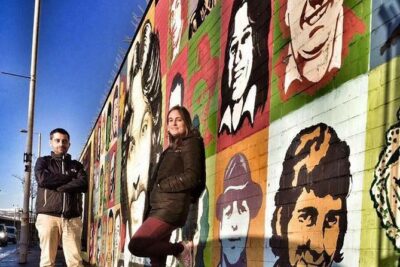
2 hours Belfast Original Drivers The Troubles Black Taxi Tour
Read our review →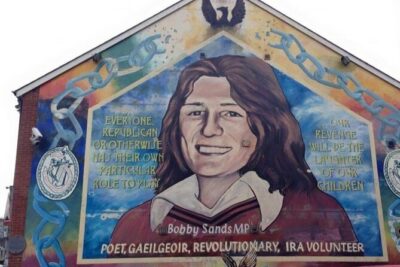
Private Political History & Murals Tour Belfast
Read our review →Browse the lists this tour appears in