
Reviewed · BELFAST CITY WALKING TOURS
A History of Terror – Belfast City Centre Walking Tour
Belfast’s centre can look calm and modern until a guide points out where bombs exploded, lives were lost, and ordinary streets became guarded zones. This 2.5-hour walking tour connects those places with the political story of The Troubles, from the late 1960s through the peace process and the questions still facing Northern Ireland.
I like the route’s clear shape, beginning at City Hall and ending beside the River Lagan, and I like the way guides such as James, Anne, Mylie, and Róisín combine public events with personal memories. The headsets are another smart touch. The main drawback is that this is more standing and listening than brisk walking, and the subject can be sad and emotionally heavy.
Key points
- A city-centre history lesson: Visit Donegall Place, Castle Lane, the Cathedral Quarter, Ann Street, and the Waterfront.
- Balanced treatment of The Troubles: The guide explains British and Irish relationships, political divisions, policing, violence, and the road to peace.
- Personal storytelling: Several guides draw on memories of growing up during the conflict, adding human detail to the wider history.
- Easy 1.5-mile route: Belfast city centre is flat, with no hills or steps, though comfortable shoes still make sense.
- Small enough to hear: Groups are limited to 25, and headsets help you follow the guide in busy streets.
- A serious but hopeful finish: The Beacon of Hope provides a useful contrast between Belfast’s troubled past and its present regeneration.
Why this Belfast walking tour matters
The most useful thing about this tour is its sense of place. You are not hearing a general lecture about Northern Ireland from inside a museum. You are standing in the streets where major events unfolded, then walking a few minutes to another location that carries a different part of the story.
That makes the history easier to follow. At City Hall, you get the broad setting: the long relationship between Britain and Ireland, the division between unionist and nationalist communities, and the reasons conflict erupted in the late 1960s. The tour then moves into specific events, showing how political tension affected shopping streets, pubs, police stations, nightlife, and daily routines.
The approach is intended to be neutral. That matters here. The Troubles are not a simple story with one side entirely right and the other entirely wrong. A good guide needs to explain competing identities, religious labels, political aims, violence by different groups, and the effect on civilians without turning the tour into a political speech.
The strongest guides appear to do just that. James is described as warm, funny, and deeply informed about The Troubles. Mylie is praised for explaining both Belfast’s past and its present in a lively way. Anne and Róisín bring memories of growing up during the conflict, while other guides add their own experiences of those years. Guide quality can vary on any walking tour, but the named guides associated with this experience have made a strong impression.
More belfast city walking tours in Belfast:
- Private Black Taxi Belfast City Tour
★ 5.0 · 2,188 reviews - Best of Belfast Walking Tour
★ 5.0 · 399 reviews - Shore Excursion from Belfast: Including Giants Causeway and Belfast City.
★ 4.0 · 192 reviews
City Hall sets the political scene
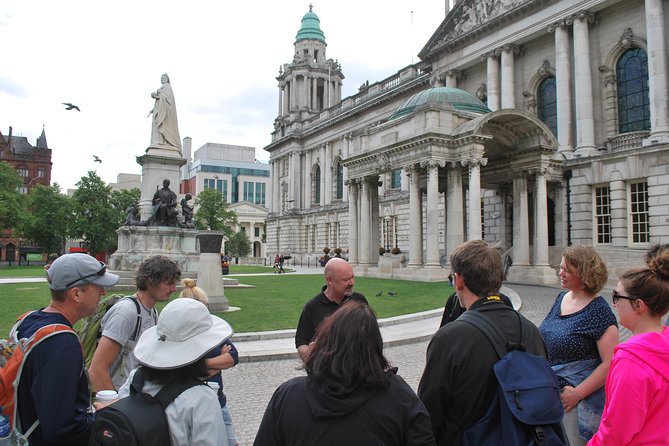
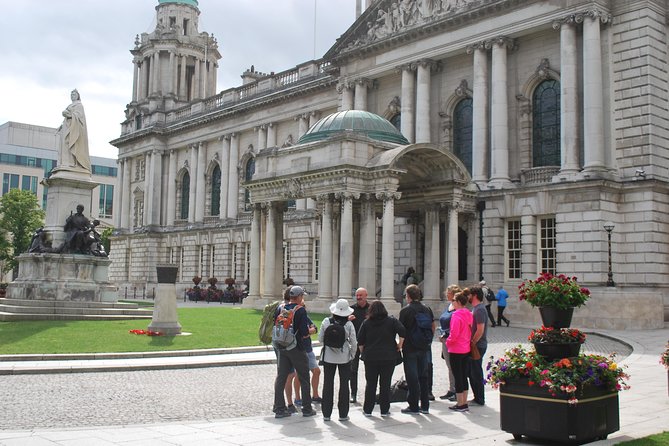
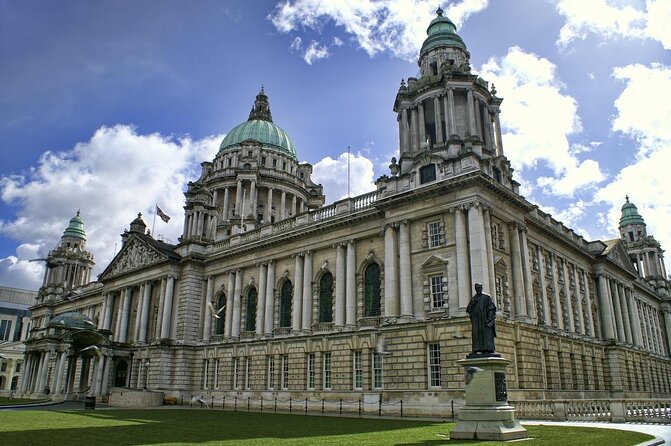
Meet at 10:30 in the grounds of Belfast City Hall, on Donegall Square North. The first 20 minutes are not a quick orientation. They establish the background needed for everything that follows.
You learn about the centuries-old relationship between Britain and Ireland, then move toward the conditions that led to the outbreak of The Troubles in the late 1960s. This is the right place to begin because City Hall represents Belfast as a civic centre, while the tour soon shows how conflict altered the ordinary life of the city around it.
You should expect to stand while listening. The route itself is not demanding, but this opening section asks you to concentrate on political terms and historical sequence. If you arrive without much knowledge of Northern Ireland, pay attention here. The later stops make more sense once you understand the basic division between those who wanted Northern Ireland to remain part of the United Kingdom and those who wanted a united Ireland.
Donegall Place reveals the danger beneath a shopping street
From City Hall, the group continues to Donegall Place. Today, this is a central shopping street, but the guide uses it to explain a 1971 bomb attack on a nightclub and the tragic events that followed.
This is one of the tour’s most effective ideas: placing difficult history in an everyday setting. Shops and traffic can make the past feel distant, yet the point is that violence took place in spaces people used for routine errands, work, and social life.
The guide also explains the creation of the Ring of Steel, the network of security controls that affected access to Belfast city centre during the conflict. This gives you a better sense of how The Troubles changed daily movement. Security was not something seen only at a military site. It shaped the experience of entering and crossing the centre.
The 15-minute stop is short, but the material is serious. You may find the tour emotionally demanding at several points, especially when it names victims and discusses loss. That is a reason to choose this experience with care, not a reason to avoid it.
Castle Lane turns a pedestrian street into a place of memory
Castle Lane is now part of the pedestrian shopping area, which makes the contrast especially sharp. The guide discusses what life was like in Belfast at the height of The Troubles and explains an event that remains strongly remembered in the city.
This stop helps move the story beyond dates and political leaders. You hear about the reality of living with fear, disruption, and uncertainty in streets that now feel ordinary. The tour’s value comes from that connection between the present appearance of Belfast and the difficult memories attached to it.
At 15 minutes, the stop does not try to tell every detail. Instead, it adds another piece to the pattern: attacks, retaliation, security measures, and the effect on people who had to carry on with work and family life. I find this kind of short, focused stop more useful than trying to force too much information into one location.
A few more Belfast trips to weigh up
- Private Political History & Murals Tour Belfast
★ 5.0 · 182 reviews - Belfast Political/history/troubles private taxi/cab tour
★ 5.0 · 69 reviews - Belfast Walking Tour: City Centre History, Troubles & Stories
★ 5.0 · 39 reviews - 1 Hour Express Belfast Taxi/Cab Tour History, Murals, Troubles
★ 5.0 · 17 reviews
The Spirit of Belfast links a nearby bar to escalation
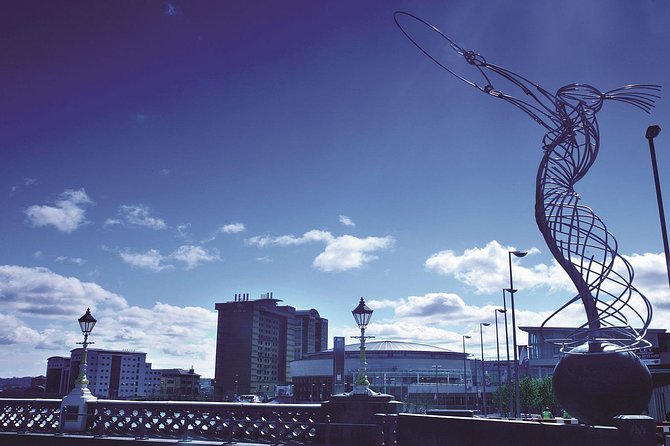
The Spirit of Belfast sculpture is known locally by the playful nickname the Onion Rings. Its official purpose is to suggest resilience, but the guide uses the artwork as a marker for a much darker sequence of events.
Standing near the sculpture, you hear about incidents that began in a nearby bar in 1971 and helped push Northern Ireland into a rapidly worsening cycle of violence. The setting gives the guide a chance to explain how individual acts and local confrontations could feed a wider political crisis.
This section is another 15 minutes. It works best if you listen for cause and effect rather than trying to memorize every name or date. The larger lesson is how quickly a tense situation can become harder to control once violence, fear, and revenge take hold.
The tour does not treat Belfast as a frozen conflict zone. The Onion Rings are part of the modern city, surrounded by public art and normal city life. That contrast keeps the tour from becoming a simple catalogue of tragedies.
The Cathedral Quarter shows how much Belfast has changed
The 20-minute walk through the Cathedral Quarter brings the tour into one of Belfast’s cultural and nightlife districts. Today, its streets and lanes contain bars, nightspots, and street art. The guide uses this modern setting to explain both major events from the conflict and the early steps toward peace.
This is likely to be one of the more atmospheric sections. You are moving through an area associated with Belfast’s current social life while being asked to imagine how different the city felt in the 1970s. The tour’s message is not that redevelopment erased the past. It is that Belfast’s present exists alongside memories of violence and loss.
The Cathedral Quarter also helps explain why a city tour can add something that a museum cannot. You see how public space changes over time. A place once shaped by danger can later become a place for art, food, music, and evening outings, while the underlying history remains important.
I would pay close attention to the guide’s discussion of the road to peace here. This part gives the tour a needed shift in tone. The story is painful, but it does not end in the worst years of the conflict.
Ann Street explains policing and the border question
At Ann Street, the group pauses beside Belfast’s largest police station. The 15-minute stop covers how Northern Ireland was policed during The Troubles and how policing changed after the peace agreement.
This is a useful addition because many accounts of the conflict focus on paramilitary groups and political leaders while giving less attention to security and law enforcement. Here, you get a clearer idea of how policing worked during the conflict and how the post-agreement system differs.
The guide also discusses Brexit and the possible effect on borders. That brings the tour into the present without pretending that every question has been settled. Northern Ireland’s constitutional position, relations with the Republic of Ireland, and links with the United Kingdom remain live issues, so this section helps connect the history to current political concerns.
Because the tour is offered in English, you need enough English to follow political explanation and spoken storytelling. The provided headsets help, especially when the group is spread along a pavement or when city noise rises around you.
The Beacon of Hope offers a measured ending
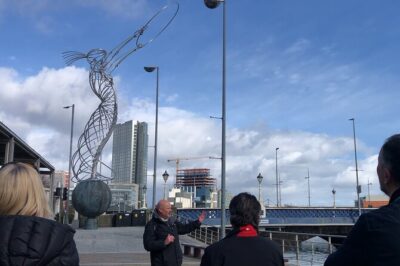
The final stop is at the Beacon of Hope beside the River Lagan, on Oxford Street. The tour ends here after about 2 hours and 30 minutes, though the actual pace can vary slightly.
The sculpture represents resilience and regeneration. It gives the guide a fitting place to compare present-day Belfast with one of the darkest periods in its past, explain how the peace was achieved, and discuss what the future might hold.
I like this ending because it avoids two common mistakes. It does not pretend that peace solved every political disagreement, and it does not leave you with only scenes of violence. Instead, you finish with a sense of progress that is real but still fragile.
From the Beacon of Hope, it is about a five-minute walk back to City Hall. That makes the end convenient if you have left luggage, a hotel nearby, or another central appointment. The route is about 1.5 miles in total, and the city centre is flat, with no hills or steps.
What the guides add to the story
The subject matter depends heavily on delivery. Dates and political labels are important, but they do not explain what it felt like to grow up during the conflict.
Personal stories help fill that gap. Anne is described as having been a child when The Troubles began, while Róisín has also drawn on firsthand experience. Mylie, although not from Belfast, has been praised for her command of the subject and her ability to present both sides clearly. That is worth noting if you assume only a Belfast-born guide can tell this story well.
James is repeatedly singled out for his energy, friendliness, and grasp of the subject. He appears to bring humor into the tour without making light of the suffering, a difficult balance in a tour about terrorism, deaths, and political conflict.
There is one practical warning. One poor experience involved a speaker failing halfway through the tour, with the guide not speaking loudly enough for everyone to hear. The headsets are included to prevent this problem, but equipment can fail. If you cannot hear, say so early and move closer rather than quietly missing half the explanation.
Is $36.06 good value for 2.5 hours?
At $36.06 per person, this is not the cheapest way to walk around Belfast. You can see City Hall, the Cathedral Quarter, and the Waterfront without paying anything.
The value comes from interpretation. You are paying for a local guide, a structured route, political context, personal accounts, and a clear explanation of places you might otherwise pass without understanding. For a first day in Belfast, that context can shape how you view the rest of the city.
The maximum group size is 25. That is not an intimate private walk, but it is small enough to keep the group together on a flat city route. Headsets are included, which is important because much of the experience involves standing outside and listening rather than walking continuously.
The route covers public spaces, so there are no admission fees. You are paying for the guide rather than entry to attractions. I consider the price fair if The Troubles are a main reason for your visit or if you want a grounded introduction before exploring museums and other sites.
Who should book this Belfast tour?
This tour suits adults and young people aged 12 and over who want to understand Belfast’s political past. It is especially useful for you if this is your first visit, since the guide connects history, geography, current politics, and the city’s changing appearance in one morning.
It also suits anyone who prefers human stories to a display of objects behind glass. The named guides use personal memories and stories about victims to make the period understandable, though that also means the experience can feel emotional.
You should choose another activity if you want a light sightseeing walk, a fast pace, or a tour focused mainly on architecture. This is a history tour first. Much of the time is spent listening at key sites, and the stories include bombings, deaths, policing, and fear.
The tour operates in all weather unless conditions force cancellation. Wear comfortable shoes, bring a waterproof jacket, and add warm clothing in winter. Belfast is flat, but rain and wind can make standing outdoors feel longer than the 1.5-mile distance suggests.
Booking, cancellation, and practical details
The start time is 10:30 am at Belfast City Hall. The end point is the Beacon of Hope on Oxford Street, near the River Lagan. Public transport is nearby, and the return walk to City Hall takes about five minutes.
You receive a mobile ticket, and the tour is conducted in English. Service animals are allowed, and most people can take part, provided they can manage the moderate walking and outdoor standing.
Free cancellation is available until 24 hours before the start time for a full refund. Changes or cancellations inside that 24-hour window are not accepted and are not refunded. If poor weather forces the operator to cancel, you are offered another date or a full refund.
The experience is generally well received, with a 5 rating from 2,882 ratings and 99 percent recommending it. Those figures point to strong value, but they do not remove the need to prepare for serious subject matter or the occasional audio problem.
Should you book A History of Terror?
Yes, if you want to understand Belfast rather than simply photograph it. The tour takes you from City Hall’s political setting to streets marked by bombings, a police station tied to the conflict, the regenerated Cathedral Quarter, and a hopeful riverfront finish.
Book it early in your Belfast stay if you can. The tour is often reserved about 24 days ahead, and its city-centre route can help you make sense of other places you visit later.
Skip it if you want cheerful sightseeing or dislike long explanations outdoors. For everyone else, the combination of specific locations, balanced history, personal memories, and a modest 1.5-mile walk makes this one of the better ways to begin learning about Belfast’s past and present.
FAQ
Where does the tour begin?
It begins at Belfast City Hall, at Donegall Square North, Belfast BT1 5GS.
Where does the tour end?
The tour ends at the Beacon of Hope on Oxford Street, Belfast BT1 3NB, beside the Waterfront and River Lagan.
How long is the walking tour?
It lasts approximately 2 hours and 30 minutes and covers about 1.5 miles.
What time does the tour start?
The scheduled start time is 10:30 am.
Is the tour suitable for children?
The minimum age is 12 years.
What happens if it rains?
The tour operates in all weather, so you should check the forecast and dress appropriately. A waterproof jacket is recommended, along with warm clothing in winter. If the operator cancels because of poor weather, you are offered another date or a full refund.
Can I cancel for a refund?
Yes. You can cancel at least 24 hours before the start time for a full refund. Cancellations or changes made less than 24 hours before the start time are not refunded or accepted.
More Walking Tours in Belfast
- Belfast Political Tour-Conflicting Stories Walking Tour
★ 4.5 · 459 reviews - Belfast Eclectic Walking City Center Experience, The Marti Way
★ 5.0 · 348 reviews - Belfast Troubles Murals Street Art and Peace Wall Walking Tour
★ 5.0 · 163 reviews - The Real Eclectic Belfast City Walking Tour/Experience.
★ 5.0 · 152 reviews
Just added around Belfast
- This is Belfast Walking Tours. Our history, our culture.★ 5.0 · 7 reviews
- Giants Causeway Private Tour★ 5.0 · 3 reviews
- Belfast City Sightseeing Tour Including Titanic Museum | 6 Hours★ 4.5 · 9 reviews
- The Single Cask Whiskey Experience★ 5.0 · 6 reviews
- Epic Escape Room Adventure to Save King’s Landing in Belfast★ 5.0 · 3 reviews
- Private Guided Walking Tour in Belfast★ 3.5 · 3 reviews
- 4 Hours Private Belfast City Tours★ 5.0 · 10 reviews
- Private Departure Transfer: Hotel to Belfast Airport★ 5.0 · 9 reviews
Belfast City Walking Tours, compared.
Shore Excursion: Giant’s Causeway Tour Including Belfast City Tour
Read our review →
Shore Excursion from Belfast: Including Giants Causeway and Belfast City.
Read our review →
Giant’s Causeway and Belfast City Murals Tour inc Game of Thrones Dark Hedges
Read our review →
World Famous Belfast City Centre Black Cab/Taxi Tour 2 Hours
Read our review →
The Real Eclectic Belfast City Walking Tour/Experience.
Read our review →
The Real Story of Belfast walking tour with a local guide
Read our review →Browse the lists this tour appears in