
Reviewed · PRIVATE
Private Belfast Explore Like a Local
Belfast’s most difficult history is painted across its walls, and this private tour puts you right beside it. You’ll see the Falls and Shankill roads, the Peace Walls, Bobby Sands mural, Divis Tower, and Clonard, then connect that story with the city’s university quarter, waterfront, and Titanic landmarks.
I like the one-to-one format, which gives your guide room to answer awkward questions and adjust the pace. I also like the included central hotel or cruise-ship pickup, plus the chance to see both famous sights and less polished places that are easy to miss on your own.
The main caution is time. The advertised visit lasts roughly three hours, yet the full route contains many stops. This is best treated as a fast overview with photo opportunities, not a leisurely tour with long visits inside every attraction. The price is also high at $638.11 per person.
What makes this Belfast tour different
- The Troubles are explained on the ground: Falls Road, Shankill Road, Divis Tower, Clonard, and the Peace Walls give the history a real setting.
- You cross Belfast’s community divide: The route visits both Republican and Loyalist areas rather than presenting only one side of the city.
- You get a private vehicle and guide: Pickup from central Belfast hotels and cruise ships is included, with navigation handled for you.
- The route covers more than murals: Botanic Gardens, Queen’s University, Belfast Castle, the Big Fish, and Titanic Quarter round out the political history.
- Guides bring personal insight: Barry and Joe are specifically associated with the experience, and local experience is a major part of the appeal.
- Most stops are short: Plan for exterior views, brief explanations, and photographs rather than full museum visits.
A quick route through Belfast’s past and present
This is an ambitious circuit. You begin in south Belfast, move west into the areas most closely linked with the conflict, then travel through the city center toward Belfast Lough and the Titanic Quarter. The tour finishes at the Crown Liquor Saloon, though the route also includes a return or additional visit to west Belfast sites.
That mix is useful. Belfast is not only a city of political murals and memorials. It is also a university city, a port, a Victorian center, and a place with grand public parks and elegant homes. The tour lets you see those contrasts in one outing.
Still, keep your expectations in check. A three-hour tour cannot give every stop equal attention. You should expect your guide to explain the setting while the vehicle does much of the moving, with time out for selected photographs.
A few more Belfast trips to weigh up
- Private Black Taxi Belfast City Tour
★ 5.0 · 2,188 reviews - 2 Hour Private Belfast Taxi Cab Tour of Troubles & Peace walls
★ 5.0 · 240 reviews - Private Political History & Murals Tour Belfast
★ 5.0 · 182 reviews
Botanic Gardens and Queen’s University
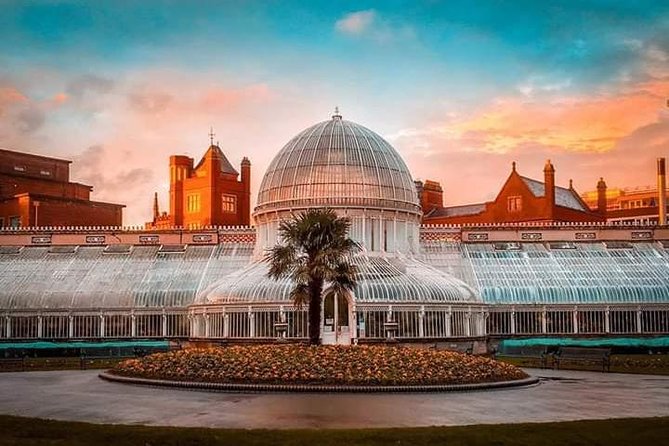
The first stop, Botanic Gardens, offers a softer opening. The 28-acre park was created in 1828 and became a public park in 1895. Its Palm House is the key feature, an early cast-iron and glass conservatory completed in 1840.
You’ll have about 30 minutes here, with admission included. That is enough to get a feel for the park and see the Victorian glasshouse, though it is not a long botanical visit. The Tropical Ravine is another notable feature, and the nearby Ulster Museum gives this part of south Belfast a strong cultural focus.
The gardens sit in the Queen’s Quarter beside Queen’s University. The university began as Queen’s College, Belfast, in 1849. Its Lanyon Building, designed by Charles Lanyon, gives the area a grand Gothic center and helps explain why this district feels so different from west Belfast.
The university stop lasts about 15 minutes. Consider it an architectural and local-life pause rather than a campus tour. Students, office workers, and residents use the gardens, so you see an everyday side of Belfast rather than a collection of monuments.
RISE and the approach to Divis
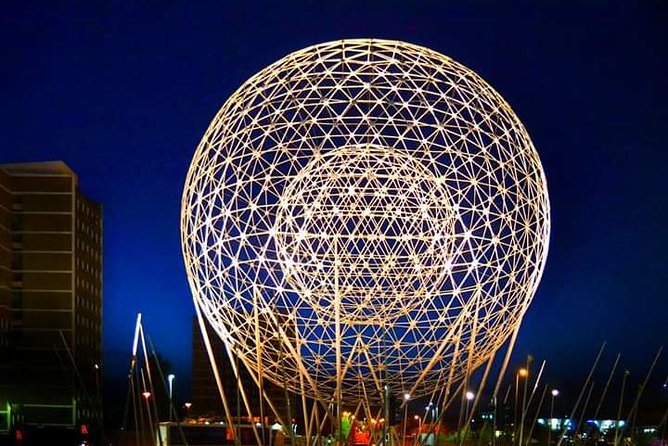
RISE is hard to miss. This large spherical metal sculpture rises above the Broadway roundabout, a major gateway near the Westlink and M1. It reaches about 37.5 meters high and is known locally by several informal names, including The Balls on the Falls.
You get about 10 minutes here, mainly for a look and photographs. The sculpture is a useful marker for the shift from the polished Queen’s Quarter into west Belfast, where the tour turns toward the history of the Troubles.
Divis Tower follows. Built in 1966 as part of a large housing complex, the 20-floor tower sits close to the junction between the Falls and Shankill areas. During the conflict, the British Army operated an observation post on its top floors.
Your guide may explain the tower through the human cost of the period, including the 1969 killing of nine-year-old Patrick Rooney and the 1981 death of INLA member Emmanuel McClarnon. These are painful subjects, and the value of having a private guide is that you can ask for context instead of relying on a quick plaque or a simplified caption.
The stop is listed at 15 minutes. You will not be touring the inside of the tower. The point is its location and what it represents.
The Peace Walls and the geography of division
The Peace Walls are the emotional center of the route. These barriers separate mainly Republican and Nationalist Catholic neighborhoods from mainly Loyalist and Unionist Protestant neighborhoods. Some reach up to eight meters high, and gates may close at night.
You visit the Peace Wall area for about 30 minutes, with the chance to sign your name and leave a message of peace and hope. That small act can feel personal, but the setting is not decorative. The walls remain physical evidence that the conflict ended without every community feeling fully secure together.
Belfast’s conflict is commonly called the Troubles. More than 3,600 people were killed and about 50,000 injured during that period, with around half of the deaths occurring in Belfast. The city is quieter now, but many neighborhoods remain socially separate.
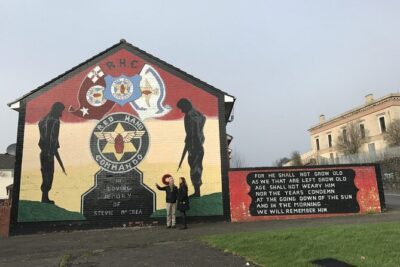
The walls also function as an outdoor gallery. Murals refer to local events and international causes, including the Spanish Civil War, the Arab-Israeli conflict, and the Iraq War. I find this part most useful when your guide explains who created a mural, whom it addresses, and how the message fits the neighborhood.
This is where a balanced guide matters. One person who took the tour felt the commentary leaned strongly toward the IRA, while other accounts praised the guide’s personal understanding and clear explanations. Northern Ireland’s past is disputed, and you should expect a point of view. Use the private setting to ask direct questions and hear how different communities describe the same events.
Same city, a completely different kind of day:
- Titanic Belfast Entrance Ticket: Titanic Visitor Experience Including SS Nomadic
★ 4.5 · 3,698 reviews - Cab Tours Belfast Famous Black Taxi Tours
★ 5.0 · 3,633 reviews - Giant’s Causeway Day Trip from Belfast
★ 5.0 · 3,480 reviews - A History of Terror – Belfast City Centre Walking Tour
★ 5.0 · 2,883 reviews
St Peter’s Cathedral and the Republican murals
St Peter’s Cathedral is on Divis Street in the Falls Road area. Construction began in the 1860s, and the church opened in 1866. Its twin spires were added in 1886, and the building later became the cathedral for the Roman Catholic Diocese of Down and Connor.
You have about 20 minutes here. The Scrabo sandstone exterior, Scottish sandstone details, and hammer-beam ceiling make this a worthwhile stop even if you are not visiting for religious reasons. The cathedral was originally built for Belfast’s growing Catholic population after the Famine, so its location is part of the story.
The Bobby Sands mural is one of the city’s best-known political images. Sands led the 1981 hunger strike while imprisoned in the Maze and died during it. The mural includes the phoenix, the lark, the harp without a crown, and the cap of liberty, all symbols tied to Irish Republican identity.
You get about 10 minutes for photographs and explanation. This is not a neutral historical display, and it should not be read that way. It is a political statement from a particular community. Your guide’s job is to place it within the conflict, not simply point at it as a colorful wall.
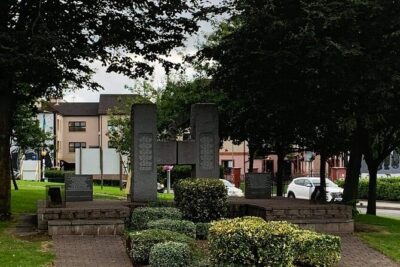
The Clonard Martyrs Memorial Garden adds another layer. It commemorates Republican volunteers, civilian casualties, and prisoners from the wider Clonard area. The garden includes memorial plaques, a Celtic cross, and lists of names.
That list of names is what makes the stop more serious than a standard mural visit. The memorial honors people according to a Republican account of the conflict, including civilians killed by Crown forces and loyalist groups. Allow yourself a quiet moment here. Fifteen minutes is brief, but the place rewards attention.
Shankill Road and the Loyalist side
The route then crosses to Shankill Road, the main road through a predominantly Loyalist area. It runs for about 2.4 kilometers west from central Belfast and is lined with shops and side streets.
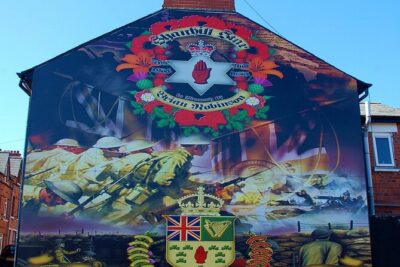
The Shankill is not simply the Protestant mirror image of the Falls. It has its own political symbols, memorials, neighborhood loyalties, and experience of violence. The tour gives you about 20 minutes here, enough to understand the setting and see how close the communities are geographically.
That closeness is the point. Falls Road and Shankill Road are near each other, yet the Peace Walls and interface zones separate them. A guide who can explain both communities without turning the visit into a political sales pitch adds real value.
This is also the part of the tour where your comfort level matters. You are visiting working-class neighborhoods with painful memories, not a theme park. Follow your guide’s instructions about where to stop and how to photograph murals or memorials.
Belfast Castle and the city’s grander side
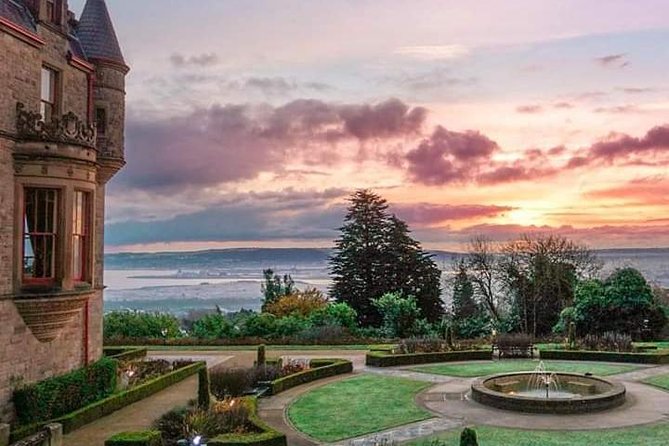
Belfast Castle changes the mood again. It sits on the lower slopes of Cavehill Country Park, about 120 meters above sea level, with views toward Belfast and Belfast Lough.
The present castle was built between 1811 and 1870 for the Donegall family and designed in a Scottish baronial style by Charles Lanyon and his son. Belfast City Council later took ownership, and the building reopened after a major refurbishment in 1988.
You have roughly 30 minutes here, but admission is not included. That distinction matters. The stop may be an exterior visit and viewpoint, or you may choose to pay for access if time allows. Confirm the plan with your guide before assuming you will tour the interior.
Look for the castle’s cat theme. The gardens contain nine cats in sculptures, mosaics, and clipped shrubs, based on a local association with Cavehill and the story that the area inspired Napoleon’s Nose, a feature linked to Jonathan Swift’s Gulliver’s Travels.
The castle gives you a welcome view of Belfast beyond the conflict districts. It also shows how sharply wealth and housing can change from one part of the city to another.
The clock, the Big Fish, and Belfast’s waterfront
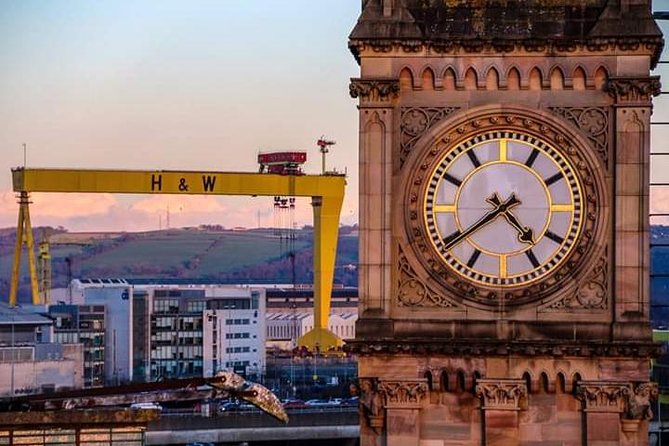
In the city center, the Albert Memorial Clock provides a compact lesson in Belfast’s engineering problems. Completed in 1869, the 113-foot tower was built on reclaimed marshland over wooden piles. It now leans about four feet from vertical, earning the local joke that it has both the time and the inclination.
The 10-minute stop is enough for a photograph and a quick explanation. Nearby public spaces have changed considerably since the clock’s days as a rough dockside area. The clock was also damaged by a Provisional IRA bomb in 1992, another reminder that the conflict reached into ordinary city streets.
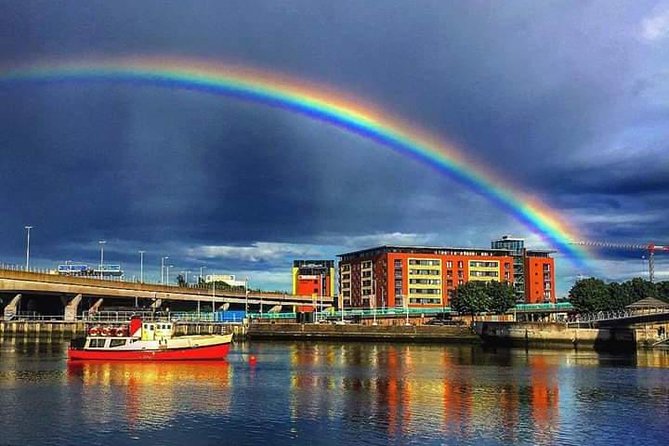
The Big Fish, or Salmon of Knowledge, is a 10-meter ceramic mosaic on Donegall Quay. Its tiles carry images, text, newspaper material, and contributions from Belfast schoolchildren. Each scale relates to some part of the city’s past or present.
This is one of the tour’s smartest public artworks because it makes history readable in small pieces. You have about 10 minutes, so take a close look rather than treating it as just another selfie stop.
Titanic Quarter and the end at the Crown
The Samson and Goliath cranes dominate the skyline near Queen’s Island. Goliath was completed in 1969 and Samson in 1974, after the Titanic era. That timing is worth remembering: the cranes did not build or host RMS Titanic, despite the common assumption.
The SS Nomadic is a tender built for the White Star Line and launched in Belfast in 1911. It carried passengers and mail to RMS Olympic and RMS Titanic, and it is the only surviving White Star Line vessel. The stop here is a five-minute photo opportunity, and admission is not included.
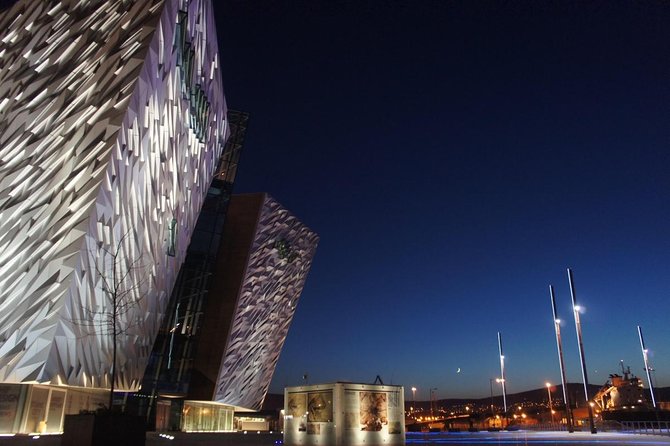
Titanic Belfast follows with another 10-minute photo stop. The attraction occupies part of the former Harland and Wolff shipyard and anchors a much larger waterfront redevelopment with apartments, studios, education spaces, and entertainment venues.
You will not have time to properly visit the Titanic Belfast museum during this tour. If the museum is a major reason for your Belfast visit, book a separate entry and allow several hours. This tour gives you orientation and photographs, not the full exhibition.
The route ends at the Crown Liquor Saloon, a famous Victorian gin palace on Great Victoria Street. Refurbished in 1885 and restored more than once, it is packed with period character. The final 30-minute stop is a pleasant contrast to the political material, and you can use it to order a drink and think over what you have seen.
Price, transport, and who gets good value
At $638.11 per person, this is an expensive choice, especially for a solo visitor or couple. The price becomes easier to justify for a larger private group if the quoted rate is fixed per person and you value door-to-door transport, a dedicated guide, and a route tailored to your interests.
The vehicle is air-conditioned, and central Belfast hotel and cruise-ship pickup and drop-off are included. Airport pickup is not offered. The private format means only your group participates, so you can ask questions freely and request more or less time in certain areas, subject to the tight schedule.
A £20 upgrade to a luxury Mercedes is available when offered. I would not treat that as essential. The guide and the quality of the explanation matter far more than the badge on the vehicle.
This tour suits you if:
- You have only one short block of time in Belfast.
- You want the Troubles explained by a local guide.
- You prefer a private vehicle to walking between scattered districts.
- You want to see both Republican and Loyalist areas.
- You are comfortable with serious political history.
- You plan to visit Titanic Belfast separately.
It is less suitable if you want long museum visits, extensive time in the gardens, or a quiet sightseeing drive with little political content. The conflict story is the core of the outing.
Practical details before you book
The activity is offered in English and uses a mobile ticket. Confirmation is provided at booking, and most people can participate. Pickup is available from central Belfast accommodations and cruise ships, but not from the airport.
The listed duration is approximately two hours and 40 minutes to three hours. Because the route includes around 20 stops, ask how much time will be spent outside the vehicle and which locations are drive-bys. This single question will help you set realistic expectations.
Free cancellation is available if you cancel at least 24 hours before the local start time. Changes or cancellations inside that window are not accepted for a refund. Tips for the guide are not included.
FAQ
How long does the private Belfast tour last?
The tour lasts approximately two hours and 40 minutes to three hours.
Is hotel pickup included?
Yes. Free pickup and drop-off are offered from central Belfast hotels and cruise ships. Airport pickup and drop-off are not offered.
Is this a private tour?
Yes. Only your group participates, with private transportation and a local qualified guide.
Is admission to Belfast Castle included?
No. Belfast Castle admission is not included. The tour does include admission at several other listed stops, while Titanic Belfast and SS Nomadic are photo stops without included admission.
Does the tour visit the Titanic Belfast museum?
It stops at Titanic Belfast for a photo opportunity. The museum admission is not included, so you would need a separate visit for the full exhibition.
Can I cancel for a full refund?
Yes, if you cancel at least 24 hours before the experience start time. Cancellations made less than 24 hours ahead are not refunded.
Should you book it?
Book this tour if the history of the Troubles is your main reason for seeing Belfast and you want a private guide to connect murals, memorials, streets, and political identities. Barry and Joe are both associated with strong local insight, and the best part of the experience is the chance to ask questions that a group tour may rush past.
I would skip it if $638.11 per person feels hard to defend or if you want to spend real time inside Belfast Castle, Titanic Belfast, or the cathedral. For a short first look at a complicated city, though, the private vehicle, central pickup, and access to both sides of west Belfast make this a useful, intense introduction.
Just added around Belfast
- Giants Causeway Private Tour★ 5.0 · 3 reviews
- This is Belfast Walking Tours. Our history, our culture.★ 5.0 · 7 reviews
- The Single Cask Whiskey Experience★ 5.0 · 6 reviews
- Epic Escape Room Adventure to Save King’s Landing in Belfast★ 5.0 · 3 reviews
- Belfast City Sightseeing Tour Including Titanic Museum | 6 Hours★ 4.5 · 9 reviews
- Private Guided Walking Tour in Belfast★ 3.5 · 3 reviews
- 4 Hours Private Belfast City Tours★ 5.0 · 10 reviews
- Private Giants Causeway Tour Tour For Up to 15 People★ 4.0 · 5 reviews
Private, compared.
2 Hour Private Belfast Taxi Cab Tour of Troubles & Peace walls
Read our review →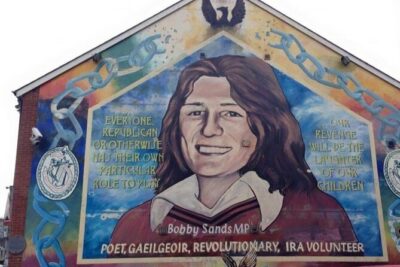
Private Political History & Murals Tour Belfast
Read our review →
Discover the City Walls – Small Group Public or Private Tour
Read our review →
Game of Thrones – Private Audi A6 tour with Richard the Wildling
Read our review →
Award Winning Exclusive 2 Hr Private Belfast Black Taxi Cab Tour
Read our review →Browse the lists this tour appears in