
Reviewed · BELFAST TROUBLES AND MURAL TOURS
Belfast Troubles Tour: Walls and Bridges
Belfast’s past is written across its streets, from the towering Peace Wall and International Mural Wall to the quiet church that complicates the usual story of religious division. This walking tour connects those places with the city’s older landmarks, so you get more than a quick look at the Troubles. You get a sense of how Belfast works, remembers, and tries to move forward.
I like the local perspective, especially when Arthur or Steve leads the walk and brings personal experience to the subject. I also like the small, private format, which gives you room to ask questions and follow the parts of the story that matter most to you. The subject can be upsetting, and the nearly three-hour walk includes graphic material, so this is not a light sightseeing stroll.
Key points to know before you book
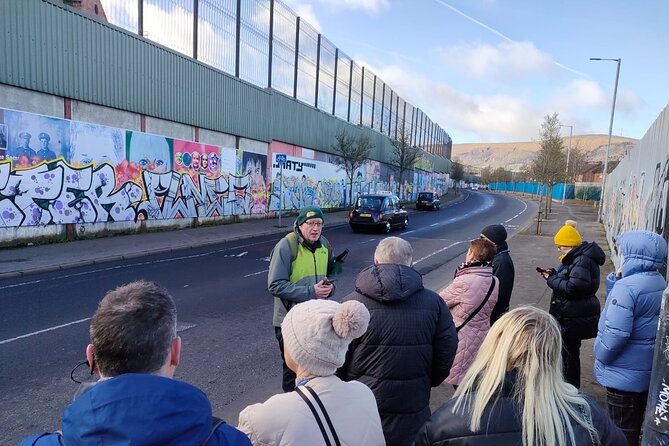
- The Peace Wall is the emotional center: You have time to study the 16-metre barriers, photograph them, and hear why they were built.
- Your guide shapes the experience: Arthur McGee and Steve are praised for clear storytelling, humor, personal memories, and a careful approach to difficult politics.
- You see both the old and new Belfast: City Hall, the Albert Clock, historic entries, churches, murals, pubs, and modern city sights all fit into the route.
- It is a serious walk, not a bus tour: Plan on about 2 hours 40 minutes to 3 hours, with a moderate level of walking.
- The tour ends with a wider view: First Presbyterian Church offers a thoughtful final stop, while the discussion turns toward Belfast’s possible future.
- Headsets may help you hear every word: They have been provided on some departures, a useful touch when the group is moving through busy streets.
Why this Belfast walk is different
Many Belfast tours focus almost entirely on the Troubles. This one uses that conflict as its main subject, but it does not leave the rest of the city behind.
You begin at Belfast City Hall, move toward the walls and murals, then return through the Cathedral Quarter, the Belfast Entries, and First Presbyterian Church. That route gives the story some depth. Belfast was not created by conflict, and it is not defined by conflict alone.
The tour also uses the word bridges in a thoughtful way. The walls are physical barriers between communities, while the bridges refer to the work of building understanding between people. That idea gives the walk a wider purpose without turning it into a lecture about easy answers.
Your guide is central to the experience. Arthur McGee is frequently praised for his humor, directness, and personal connection to Belfast. Steve is also singled out for informative commentary and personal stories. The guide may vary, but you can expect someone presenting the material as a local rather than as a distant academic.
That matters here. The Troubles are not an abstract chapter in a textbook. They shaped homes, neighborhoods, families, politics, and daily routines. A local guide can explain those effects in a way that dates and labels alone cannot.
More belfast troubles and mural tours in Belfast:
- Belfast’s Political Mural Taxi Tour
★ 5.0 · 1,180 reviews - Famous 1.5 hour Belfast Murals Tour
★ 5.0 · 477 reviews - Belfast Murals Taxi Tour
★ 5.0 · 341 reviews
City Hall sets the tone in 10 minutes
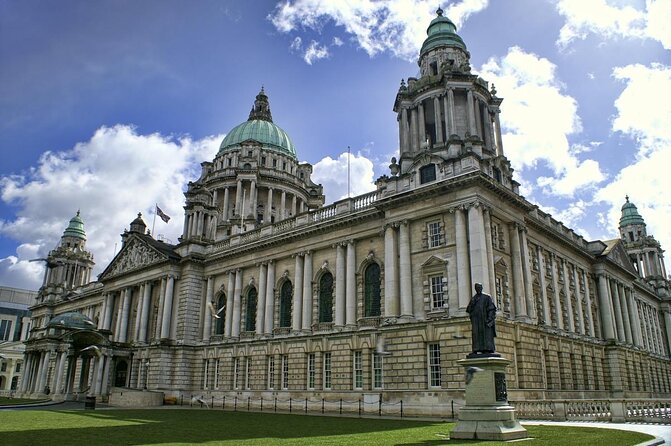
The tour starts at Belfast City Hall, an impressive place to get your bearings. Its dome rises 174 feet, and the interior uses several types of marble, including Italian marble and Greek Cipollino marble. Stained glass adds another layer of detail.
You do not spend a long time inside, and admission is free. Still, the building matters because it represents Belfast’s civic identity and the confidence of a city shaped by industry and commerce. Its grand scale makes a sharp first impression.
This is a useful opening stop because it gives you a sense of Belfast beyond the Troubles. Before hearing about division, you see the city’s central public building and learn something about its ambition.
The route also passes the Big Fish, a modern sculpture by Dan George. Its Celtic design refers to Belfast’s engineering, industry, and communities. The work is easy to appreciate quickly, but your guide can use it to connect the city’s older identity with its present-day public spaces.
The International Mural Wall and the Peace Wall
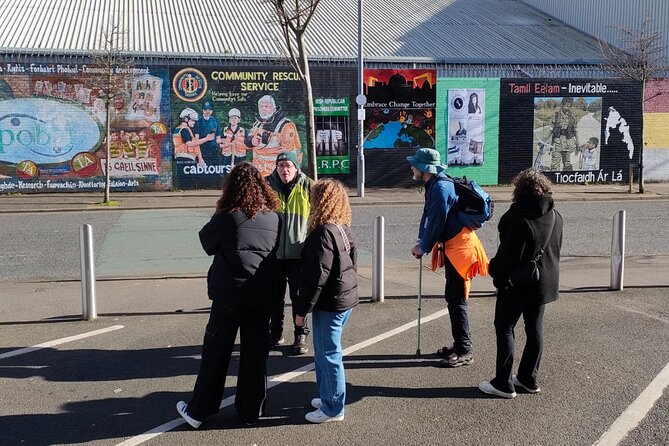
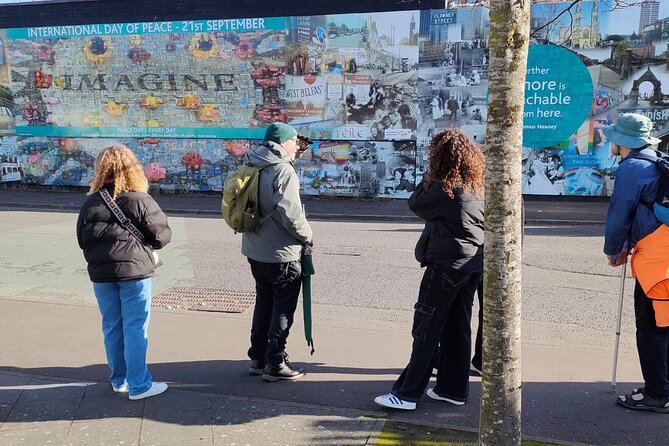
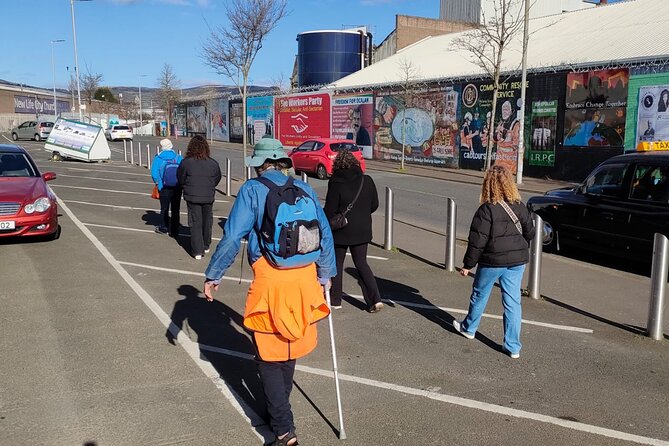
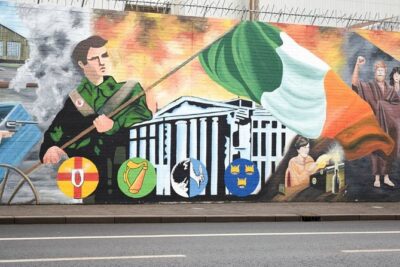
The section near Divis Street is where the tour becomes more direct. At the International Wall of Murals, you encounter political art that has served as a form of public communication.
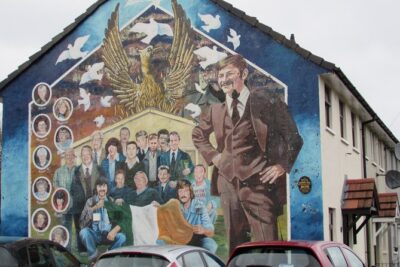
Murals in Belfast are not simply decoration. They can express memory, politics, solidarity, identity, and anger. Your guide explains how murals function as media, which helps you read them as part of an ongoing conversation rather than as colorful backdrops for photographs.
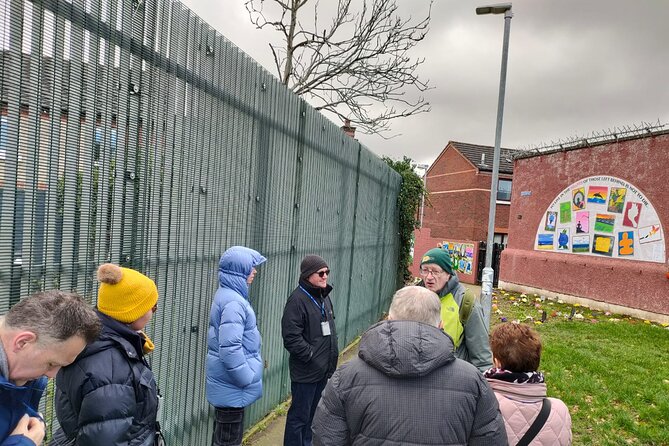
Then comes the Peace Wall. These barriers divide Protestant and Catholic communities in parts of Belfast. They rise about 16 metres and are topped with mesh designed to stop petrol bombs. The physical scale is hard to ignore, particularly when you consider that these structures remain part of ordinary neighborhood life.
You have around 15 minutes at the wall, enough time to look closely and take photographs while listening to a detailed explanation. That pause is important. A rushed drive past the wall can show you its size, but walking beside it gives you time to consider what it means.
The wall can also be difficult to interpret without context. It was built as a safety measure, yet it is also a powerful symbol of separation. The tour does not treat it as a simple attraction. You are asked to think about why barriers were built, why they lasted, and what it takes to replace them with trust.
The subject matter includes graphic descriptions of violence. If you want a polished city tour with only cheerful facts, choose another outing. If you want a frank account of the conflict, this is where the tour earns its value.
The Albert Clock and Belfast’s older foundations
The Albert Memorial Clock Tower is a quick stop, lasting about five minutes. Belfast’s answer to London’s leaning tower, it rises 113 feet and leans about four feet from the perpendicular.
The clock occupies the spot connected with the crossing that established Belfast as a town. It also has a statue of Prince Albert and appeared in the film noir Odd Man Out, starring James Mason.
This short visit is a reminder that Belfast’s story includes more than political division. The clock is an architectural landmark, a bit of local trivia, and a clue to the city’s older urban structure.
You will not have time for a long architectural study here, but your guide can point out the details that are easy to miss. The lean is noticeable, though not dramatic enough to make the tower look ready to fall. It is a good example of the small details that make a walking tour more rewarding than a simple list of major sights.
Same city, a completely different kind of day:
- Titanic Belfast Entrance Ticket: Titanic Visitor Experience Including SS Nomadic
★ 4.5 · 3,698 reviews - Cab Tours Belfast Famous Black Taxi Tours
★ 5.0 · 3,633 reviews - Giant’s Causeway Day Trip from Belfast
★ 5.0 · 3,480 reviews - A History of Terror – Belfast City Centre Walking Tour
★ 5.0 · 2,883 reviews
Cathedral Quarter and the Belfast Entries
The Cathedral Quarter provides a change of mood. This part of central Belfast is known for pubs, restaurants, colorful murals, cobbled streets, and narrow passages. It has become a popular social area, but the older stonework and tight lanes preserve a feel of Belfast before modern redevelopment.
Your guide connects the district with music, local culture, and major rock events. The result is a more rounded portrait of the city. Belfast is not only a place where politics happened. It is also a place where people gathered, worked, made music, drank, argued, and built ordinary lives.
The Belfast Entries take you through historic passageways that are easy to miss if you do not know where to look. You move through lanes linked with revolution, intrigue, and pubs. This is one of my favorite types of urban sightseeing because the places are modest, yet they reveal how a city was actually used.
Do not expect grand monuments at every turn. The appeal is in the texture of the route and in the stories attached to the spaces between major streets. A guide is essential here. Without one, you might walk past the entrances without realizing their importance.
First Presbyterian Church ends the walk on a thoughtful note
First Presbyterian Church, on Rosemary Street, is the final stop. It dates from 1783 and has an elliptical interior that John Wesley admired when he preached from its pulpit.
The church offers a useful challenge to the simplest version of Belfast’s past. Its congregation took important positions on civil and religious freedom, showing that the city’s history cannot be reduced to two fixed communities with identical views inside each group.
You have about 10 minutes to look around and take photographs. The building is only about five minutes from City Hall, making the ending convenient if you want to continue exploring central Belfast afterward.
Finishing here is a smart choice. After the heavy material at the Peace Wall, the church brings the discussion back to ideas, conscience, and the possibility of people crossing old divisions. The tour does not pretend that Belfast’s problems are solved. It gives you a more useful closing thought: understanding is work, and it begins with questioning your own assumptions.
The guide makes or breaks the experience
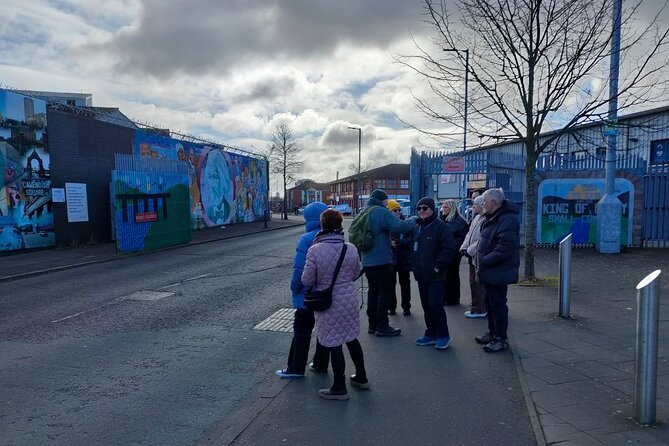
This is a private tour with a maximum of 16 people, and that format is especially helpful for a subject this personal. You can ask about politics, identity, religion, or daily life without trying to catch a guide’s voice from the back of a large bus.
Arthur McGee receives especially strong praise for combining humor with painful material. He is described as direct, entertaining, and willing to discuss the conflict without polishing away its worst parts. His personal memories help place the Troubles in lived experience rather than leaving them as a sequence of dates.
Steve is also praised for informative commentary and personal stories. If you are assigned either guide, expect an approach that mixes history, politics, economics, music, and social life.
The humor needs some explanation. It is not there to make the Troubles seem amusing. It gives you occasional breathing room during a difficult subject and helps keep the three-hour walk from becoming a continuous block of grim detail.
You may also receive a headset. That is useful when the group is spread out or when traffic and city noise compete with the guide. Since the tour can include detailed explanations, being able to hear clearly makes a real difference.
How much walking and time to allow
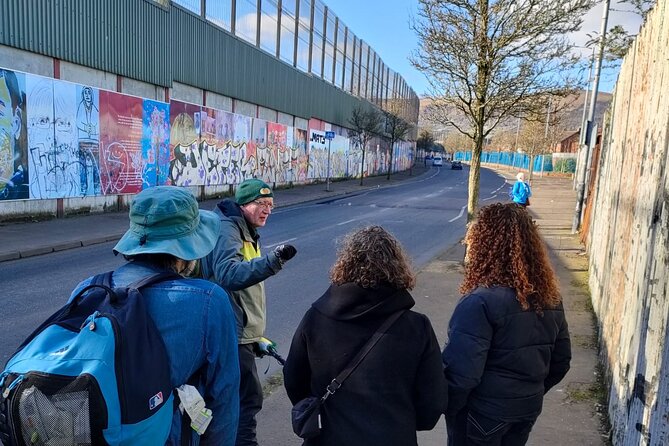
The advertised duration is about 2 hours 40 minutes to 3 hours. Some descriptions refer to a three-hour walk, while one account described a longer experience before the guide clarified that the standard tour lasts three hours.
Plan for three hours rather than trying to squeeze it between tight appointments. The route includes several stops, but the walking between them is part of the experience. You need a moderate level of physical fitness, and comfortable shoes are a practical choice.
The tour begins at City Hall, Belfast BT1 5GS. It ends at First Presbyterian Church on Rosemary Street, Belfast BT1 1QB, within sight of City Hall. That compact ending makes it easy to continue your day in the city center.
The minimum age is 14, and the tour is not designed for young children. Graphic content is part of the experience, so parents should consider both the age rule and the emotional weight of the material.
Is $33.29 a fair price?
At $33.29 per person, the tour offers solid value if you want context rather than a quick photo stop. You are paying for roughly three hours of guiding, a private format, and access to a local explanation of places that can be hard to understand on your own.
The value is strongest for first-time visitors. You can see City Hall, the Big Fish, the Albert Clock, murals, the Peace Wall, the Cathedral Quarter, the Belfast Entries, and First Presbyterian Church in one continuous route. More important, you learn how those places connect.
A bus tour may cover more ground with less walking, but it can make the city feel distant. This route puts you beside the walls and into the lanes. You have time to look, ask questions, and notice how neighborhoods change from one part of Belfast to another.
The price is less appealing if you only want landmark sightseeing or if political history is not your interest. The tour spends real time on the Troubles, including graphic material and difficult stories. That focus is the reason to book it, not an incidental feature.
Who should book this Belfast Troubles Tour?
I would recommend it to you if you want a clear introduction to Belfast’s recent past and prefer walking to sitting on a bus. It suits history-minded visitors, people interested in political conflict, and anyone who wants a local voice rather than a generic city commentary.
It is also a strong first activity in Belfast. The route gives you a framework for later visits to museums, murals, neighborhoods, or political sites. You may leave with more questions than answers, but that is useful when the subject is as complicated as this one.
Go with an open mind. The guide aims for a balanced presentation, but no account of the Troubles can remove every point of tension. You may hear stories that challenge your own political assumptions or expose the limits of simple labels.
I would skip it if you need a relaxed, family-focused outing, dislike graphic descriptions, or have difficulty walking for close to three hours. The tour is serious, even when the guide uses humor.
Free cancellation is available up to 24 hours before the start time for a full refund. Changes or cancellations made inside that window are not accepted, and the tour requires a minimum number of participants to operate.
Should you book it?
Book this tour if you want Belfast explained from street level, with time at the Peace Wall and a guide who can connect public history with personal experience. Arthur McGee is a particularly strong choice when available, and Steve also brings clear storytelling and first-hand perspective.
You should not book it simply because the Peace Wall is a famous photo stop. The real value lies in the connections between the wall, the murals, the city’s older buildings, and the people who lived through the conflict.
For many visitors, this will be the most useful three hours they spend in Belfast. It is honest, sometimes painful, often funny, and focused on helping you see the city as more than a symbol of division.
FAQ
How long does the Belfast Troubles Tour last?
The tour lasts approximately 2 hours 40 minutes to 3 hours. You should allow three hours so you are not rushed.
Where does the tour begin?
It begins at Belfast City Hall, Belfast BT1 5GS, United Kingdom.
Where does the tour end?
The walk ends at First Presbyterian Church on Rosemary Street, Belfast BT1 1QB, within sight of Belfast City Hall.
Is the tour suitable for children?
The minimum age is 14. The tour is not aimed at children and includes graphic content.
How many people can join the tour?
The activity has a maximum of 16 travelers and is described as a private tour.
Can I cancel for a full refund?
Yes. You can cancel at least 24 hours before the experience start time for a full refund. Cancellations or changes made less than 24 hours before the start time are not accepted.
Just added around Belfast
- Giants Causeway Private Tour★ 5.0 · 3 reviews
- This is Belfast Walking Tours. Our history, our culture.★ 5.0 · 7 reviews
- The Single Cask Whiskey Experience★ 5.0 · 6 reviews
- Epic Escape Room Adventure to Save King’s Landing in Belfast★ 5.0 · 3 reviews
- Belfast City Sightseeing Tour Including Titanic Museum | 6 Hours★ 4.5 · 9 reviews
- Private Guided Walking Tour in Belfast★ 3.5 · 3 reviews
- 4 Hours Private Belfast City Tours★ 5.0 · 10 reviews
- Private Departure Transfer: Hotel to Belfast Airport★ 5.0 · 9 reviews
Belfast Troubles and Mural Tours, compared.
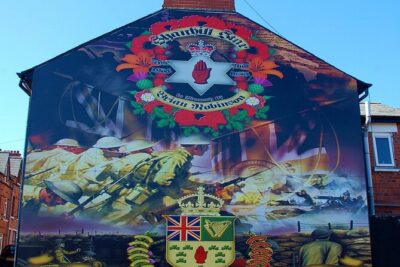
2 Hour Private Belfast Taxi Cab Tour of Troubles & Peace walls
Read our review →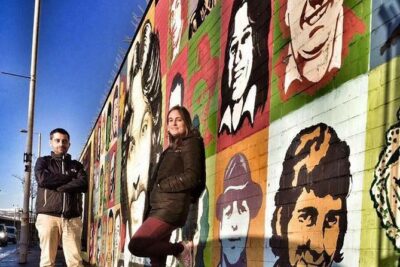
2 hours Belfast Original Drivers The Troubles Black Taxi Tour
Read our review →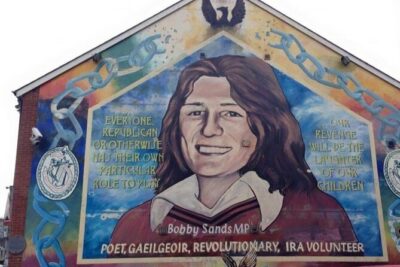
Private Political History & Murals Tour Belfast
Read our review →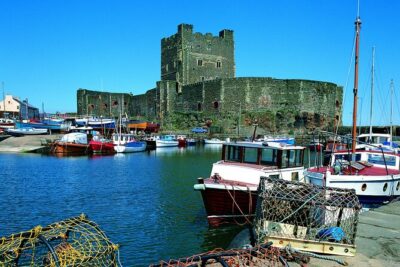
Giant’s Causeway and Belfast City Murals Tour inc Game of Thrones Dark Hedges
Read our review →Browse the lists this tour appears in